Trump vs NATO: Why He Wants Out, What the Law Really Says & the Global Chaos That Follows
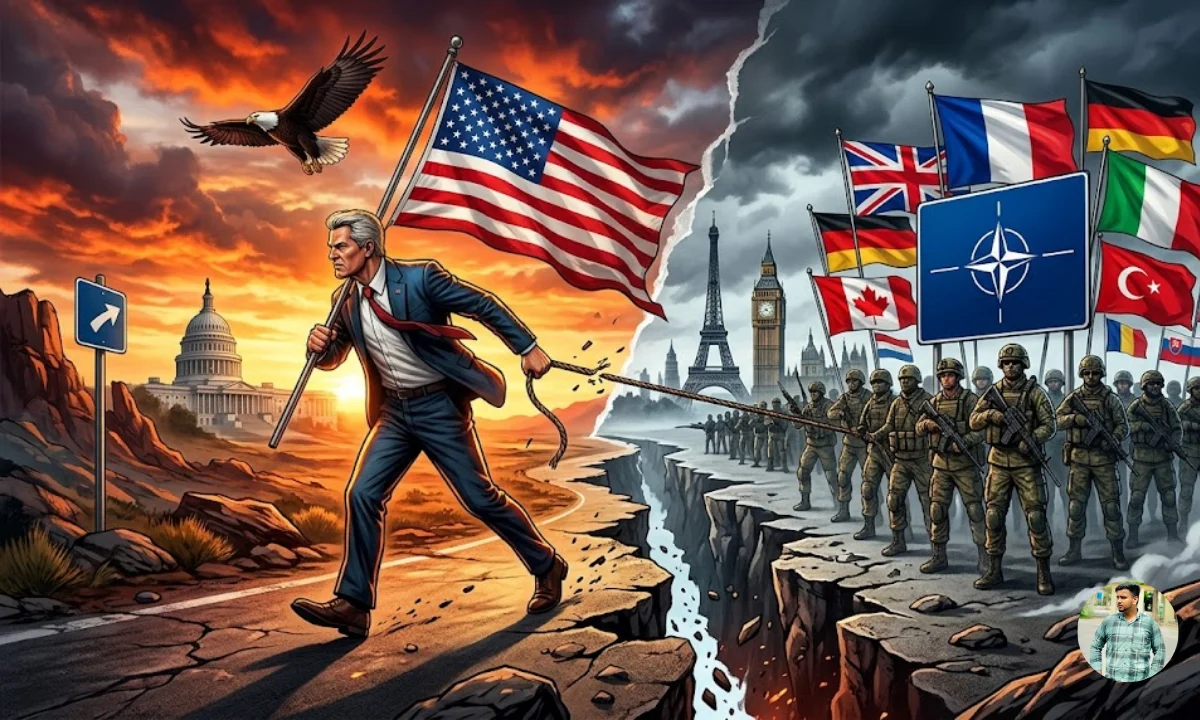
Trump vs NATO:
The North Atlantic Treaty Organization faces its most serious challenge since 1949. President Donald Trump calls it a “paper tiger.” He says American withdrawal is “beyond reconsideration.” European capitals are in panic mode. But can he actually do it? And what happens if he succeeds?
This is not another political bluff. The Iran war has exposed deep fractures in the 77-year-old alliance. When the United States asked for help securing the Strait of Hormuz, NATO allies refused. Now Trump is threatening consequences that could reshape global security forever.
In this article we will breakk down exactly why Trump wants to leave NATO, the legal barriers standing in his way & the catastrophic fallout that would follow an American exit.
So if your are geopolitics student or preparing for any exam then this post is designed is for you, Keep reading….
Table of Contents
Why Trump Wants America Out of NATO
1) The Paper Tiger Comment That Shook Europe
On April 1, 2026, President Trump gave an interview to Britain’s Daily Telegraph that sent shockwaves through NATO headquarters in Brussels. When asked if he would reconsider American membership after the Iran war, his response was blunt: “Oh yes, I would say it’s beyond reconsideration. I was never swayed by NATO. I always knew they were a paper tiger, and Putin knows that too, by the way.”
This was not casual rhetoric. It was a calculated attack on the alliance’s credibility. Trump framed NATO as a hollow organization that looks strong on paper but fails when tested.
2) The Iran War Trigger
The immediate trigger for Trump’s latest outburst is the ongoing conflict with Iran. The war began on February 28, 2026, when the United States and Israel launched air strikes against Iranian targets. Within days, Iran effectively blockaded the Strait of Hormuz, a narrow waterway that handles roughly 25% of the world’s maritime oil trade.
Trump asked NATO allies to join a coalition to reopen the strait. They refused. European nations including France, Germany, Italy, and the United Kingdom declined to send warships. Spain closed its airspace to American military aircraft. Italy refused access to the Sigonella air base in Sicily. France blocked Israel from using French airspace to transport weapons.
The President viewed this as betrayal. He told the Telegraph: “We’ve been there automatically, including Ukraine. Ukraine wasn’t our problem. It was a test, and we were there for them, and we would always have been there for them. They weren’t there for us.”
3) The Burden-Sharing Argument
Trump’s frustration with NATO predates the Iran war. For years, he has complained that European countries free-ride on American military power. The statistics support part of his argument.
In 2025, NATO members spent a combined $1.4 trillion on defense. The United States contributed $838 billion of that total, representing 60% of combined nominal defense expenditure. European allies and Canada together spent $574 billion.
However, European contributions are growing rapidly. Non-US NATO defense spending increased by 20% in real terms compared to 2024. All 32 member states now meet the baseline target of spending 2% of GDP on defense. Poland spends 4.3%, Lithuania 4%, and Latvia 3.74%.
Trump remains unconvinced. He told the Telegraph that the UK “doesn’t even have a navy” and accused Prime Minister Keir Starmer of wasting money on “costly windmills.”
4) The Strategic Calculation
Trump’s position reflects a fundamental rethinking of American foreign policy. He views NATO as an outdated arrangement from the Cold War era that no longer serves American interests. In his calculation, the United States bears the costs and risks while European allies benefit from stability without contributing proportionally.
Secretary of State Marco Rubio echoed this sentiment on Fox News: “We’re going to have to reexamine whether or not this alliance that has served this country well for a while is still serving that purpose, or is it now become a one-way street where America is simply in a position to defend Europe, but when we need the help of our allies, they’re going to deny us basing rights and they’re going to deny us overflight.”
Also Read: Trump Threatens to Bomb Iran’s Bridges and Power Plants
Can Trump Leave NATO Without Congress? The Legal Reality
1) The 2023 Law That Blocks Unilateral Withdrawal
The short answer is no. President Trump cannot legally pull the United States out of NATO without congressional approval. This is not a matter of executive discretion. It is federal law.
In 2023, Congress passed and President Joe Biden signed legislation specifically designed to prevent exactly what Trump is now threatening. The provision was included in the National Defense Authorization Act for fiscal year 2024.
The law states that the president “shall not suspend, terminate, denounce, or withdraw the United States from the North Atlantic Treaty, done at Washington, DC, April 4, 1949, except by and with the advice and consent of the Senate, provided that two-thirds of the Senators present concur, or pursuant to an Act of Congress.”
This means any withdrawal requires either:
- A two-thirds majority vote in the 100-member Senate (67 votes)
- A separate act of Congress passed by both chambers
The legislation was co-sponsored by Democratic Senator Tim Kaine of Virginia and then-Republican Senator Marco Rubio of Florida. Rubio now serves as Trump’s Secretary of State.
2) The Constitutional Ambiguity
The legal situation is complicated by constitutional ambiguity. The United States Constitution explicitly gives the president power to make treaties with the advice and consent of the Senate, requiring a two-thirds majority. However, the Constitution is completely silent on treaty withdrawal.
This silence has created decades of debate about presidential versus congressional authority. In 2020, during Trump’s first term, the Department of Justice’s Office of Legal Counsel issued an opinion stating that the president has exclusive authority to withdraw from treaties without congressional approval.
If Trump attempts to withdraw from NATO unilaterally, his administration could cite this 2020 opinion and argue that the 2023 law is unconstitutional. The case would almost certainly end up before the Supreme Court.
3) The Supreme Court Factor
Legal experts are divided on how the Supreme Court would rule. The court’s conservative majority has frequently ruled in Trump’s favor on executive power questions. However, treaty withdrawal presents unique constitutional issues.
Ilaria Di Gioia, a senior lecturer in American law at Birmingham City University, explained to TIME: “Trump could seek to circumvent Congress’ statutory constraint by invoking presidential authority over foreign policy, an approach he has floated before to bypass congressional limits on treaty withdrawal. It is unclear whether any party would have legal standing to challenge such a move in court.”
Curtis Bradley, a distinguished service professor of law at the University of Chicago, noted there is some precedent for unilateral presidential withdrawal. President Jimmy Carter withdrew from a mutual defense treaty with Taiwan in 1978 without congressional approval.
However, the 2023 law changes the legal landscape. Scott Anderson, senior editor of Lawfare, stated: “If President Trump does this, he’s going to have a legal fight on his hands and it’s far from clear that he’s going to win.”
4) The Political Reality in Congress
Even if the legal path were clear, the political math in Congress makes withdrawal difficult. Senate Minority Leader Chuck Schumer has vowed that the Senate “will not vote to leave NATO and abandon our allies just because Trump is upset they wouldn’t go along with his reckless war of choice.”
Senate Republican Leader John Thune has also stated that Congress would need to weigh in on any withdrawal decision. “Yeah, absolutely, I don’t think you can make that kind of a decision unilaterally,” Thune told the Washington Examiner.
The Senate contains 47 Democrats who would almost certainly oppose withdrawal. Several Republican defense hawks, including Representative Don Bacon of Nebraska, have also pledged to block any NATO exit. Bacon warned that if Trump pulls out of NATO, “his presidency will never recover” and Republicans would struggle to win national elections for several cycles.
5) The Congressional Pressure Valve
Congress has already taken steps to constrain Trump’s options beyond the 2023 law. The House of Representatives passed a defense bill in late 2025 that sets a minimum of 76,000 US troops in Europe. The Pentagon currently maintains approximately 80,000 to 90,000 troops on the continent, with about 65,000 permanently stationed and the remainder on rotational deployment.
This troop floor creates another legal barrier. Even if Trump withdraws from the treaty, he would face congressional restrictions on removing the physical military presence that underpins American commitment to European security.
What Happens If the USA Leaves NATO: The Global Consequences
1) The Immediate Security Vacuum
If the United States leaves NATO, the consequences would be immediate and severe. NATO is not merely a diplomatic arrangement. It is a military organization built around American power.
The United States provides approximately 60% of NATO’s defense capability. Washington contributes $838 billion of the alliance’s $1.4 trillion combined defense spending. America supplies the nuclear deterrent, strategic airlift, intelligence networks, command and control systems, and the bulk of combat-ready forces.
Without the United States, NATO would lose its most powerful member overnight. The alliance would not simply be weakened. It would be transformed into something fundamentally different.
2) Article 5: The Collapse of Collective Defense
NATO’s power rests on Article 5 of the Washington Treaty. This provision states that an armed attack against one ally is considered an attack against all. It has been invoked only once in NATO’s history: after the September 11, 2001 terrorist attacks on the United States.
Article 5 creates deterrence through certainty. Potential aggressors know that attacking one NATO member means war with the entire alliance. This certainty has prevented major conflict in Europe for 77 years.
If the United States withdraws, Article 5 becomes hollow. European nations would still pledge mutual defense, but without American military power behind that pledge, the guarantee loses credibility. As one expert noted, if NATO members “can’t trust that the U.S. will honor Article 5, the alliance is already broken in the way that matters most.”
Ivo Daalder, who served as President Barack Obama’s ambassador to NATO, explained the practical reality to the Telegraph: “What the president can do, there’s no question about that, is withdraw all American troops, withdraw all Americans from the command structure, and say Article 5, we don’t count our military capabilities, let alone nuclear, if you get attacked. All perfectly legal.”
3) Russia’s Strategic Opportunity
A US withdrawal from NATO would represent the greatest strategic gift to Russia since the end of the Cold War. Vladimir Putin has worked for years to undermine the alliance and sow division among its members. American withdrawal would deliver his goal in a single stroke.
Russia would not need to defeat Europe militarily. It would only need to probe, exploit hesitation, and identify where political resolve falters. The credibility of collective defense would be thrown into question, and it is precisely that ambiguity which invites testing.
For four years, Russia has assiduously avoided direct confrontation with NATO powers, refusing to bomb air bases and railway depots in Poland that supply Ukraine. Remove American conventional and nuclear power from the equation, and those risks suddenly look much more palatable to Moscow.
4) Europe’s Defense Crisis
European nations face an impossible timeline for replacing American capabilities. The United States provides capabilities that Europe cannot easily replicate: intelligence networks, command-and-control infrastructure, strategic lift for moving troops and equipment, and missile defense systems.
There would be a dangerous interval in which the political framework weakens faster than the balance of power can adjust. European nations would need to increase defense spending sharply and immediately, not defer increases to future years.
The United Kingdom illustrates the challenge. Britain has underinvested in defense because it operated within a system where America over-provided. That implicit subsidy would end. The UK would need to rebuild capabilities long underwritten by the United States: logistics, airlift, naval power, stockpiles, and industrial capacity.
The nuclear question would also return. Britain’s Trident nuclear program remains operational, but its ecosystem is deeply entwined with the United States. France would assume greater prominence as Europe’s only other nuclear power. However, Britain has little confidence in relying on a French deterrent, and even less willingness to depend on it in place of the United States.
5) Economic Consequences and Market Volatility
The economic effects would be significant though less immediate than the security impacts. Higher defense spending would create fiscal strain across Europe. Investors would face uncertainty as the security framework that has underpinned European stability for generations crumbles.
If American policy becomes more transactional, US firms may become more cautious about European markets. European states would hedge more broadly, seeking new partnerships and reducing dependence on any single power. Security fragmentation rarely remains confined to the military domain.
The Dallas Federal Reserve has quantified the potential effects of the current Strait of Hormuz closure on global output. A complete cessation of oil exports from the Gulf region would remove close to 20% of global oil supplies from the market. A NATO collapse would compound this economic stress by adding security uncertainty to energy disruption.
6) America’s Own Losses
The United States would also suffer fundamental losses from NATO withdrawal. The alliance is often portrayed in Washington as a burden. In reality, it is one of America’s most effective instruments of power. NATO allows the United States to organize and direct allied strength at relatively low cost.
Outside NATO, the United States would still be a superpower, but one forced to manage alliances on a more conditional, bilateral basis with less control over how they function. The US would lose access to military bases across Europe that enable global power projection.
The United States has reduced its green-water navy in favor of a blue-water force. Without European bases, America’s ability to project power into the Middle East, Africa, and Asia would be severely constrained. The lack of bases would thwart America’s ability to fly forces around the world and sustain operations in distant theaters.
NATO also disciplines behavior within the West itself. Issues like Trump’s interest in acquiring Greenland illustrate the point. As long as Denmark and the United States sit within the same alliance, serious coercion is strategically incoherent. Remove that framework, and barriers begin to fall away. What was once unthinkable becomes easier to contemplate.
7) The Rise of Alternative Powers
A NATO collapse would accelerate the shift toward a multipolar world. Countries across Europe, Africa, and the Middle East would tilt toward Russia and China as American reliability comes into question.
India represents one potential beneficiary of this shift. The country has already signed defense cooperation agreements with the European Union including co-development of defense systems, manufacturing partnerships, and supply chain integration. India offers cost-effective production, a skilled workforce, and political stability compared to alternatives like China or Russia.
If NATO weakens, India could become a major defense partner for Europe as it seeks to diversify suppliers and build strategic autonomy. This would represent a significant vote of confidence in India’s industrial trajectory and could accelerate its transition from defense importer to manufacturing hub.
The Three Scenarios: What Actually Happens Next
1) Scenario One: Negotiation and Pressure
The most likely outcome is that Trump uses the withdrawal threat as leverage to extract concessions from NATO allies. He has employed this tactic before, successfully pressuring members to increase defense spending during his first term.
NATO Secretary General Mark Rutte is scheduled to visit Washington in the coming days. Rutte has earned a reputation as a “Trump whisperer” who can manage the President’s impulses. European officials hope he can defuse the current crisis.
Under this scenario, Trump continues to criticize NATO publicly while maintaining the underlying relationship. European nations increase defense spending further and offer limited cooperation on Iran-related issues. The alliance survives but is weakened by the constant friction.
2) Scenario Two: Legal Confrontation
If Trump attempts to withdraw unilaterally, the issue would immediately go to federal court. Congressional leaders would likely file suit to block the withdrawal. The case would eventually reach the Supreme Court.
The outcome is uncertain. The Court could rule that the 2023 law is constitutional and block the withdrawal. Alternatively, it could side with the executive branch and affirm presidential authority over treaty termination. A third possibility is that the Court declares the issue a “political question” that must be resolved by the elected branches rather than the judiciary.
Regardless of the outcome, a legal battle would create months or years of uncertainty. European allies would begin planning for a post-American future even if the legal challenge ultimately succeeds.
3) Scenario Three: Degradation Without Exit
Trump might choose a middle path that stops short of formal withdrawal but hollows out American participation. This could include:
- Withdrawing US troops from Europe while keeping them technically assigned to NATO
- Reducing intelligence sharing with allied governments
- Weakening commitment to Article 5 without formally renouncing it
- Skipping NATO summits and reducing high-level engagement
- Redirecting military resources to other theaters
This approach would achieve many of Trump’s goals without triggering a direct legal confrontation. It would also leave NATO in a weakened, ambiguous state that might be worse than a clean break. As one German official told Politico: “With Trump in office, NATO is worthless. We might have NATO, but we no longer have an alliance.”
Related Posts :
Share This Post