ISS Space Potato: Viral “Alien Egg” Or Future Of Space Farming? Shocking Truth Revealed
ISS Space Potato: Viral “Alien Egg” Or Future Of Space Farming? Shocking Truth Revealed
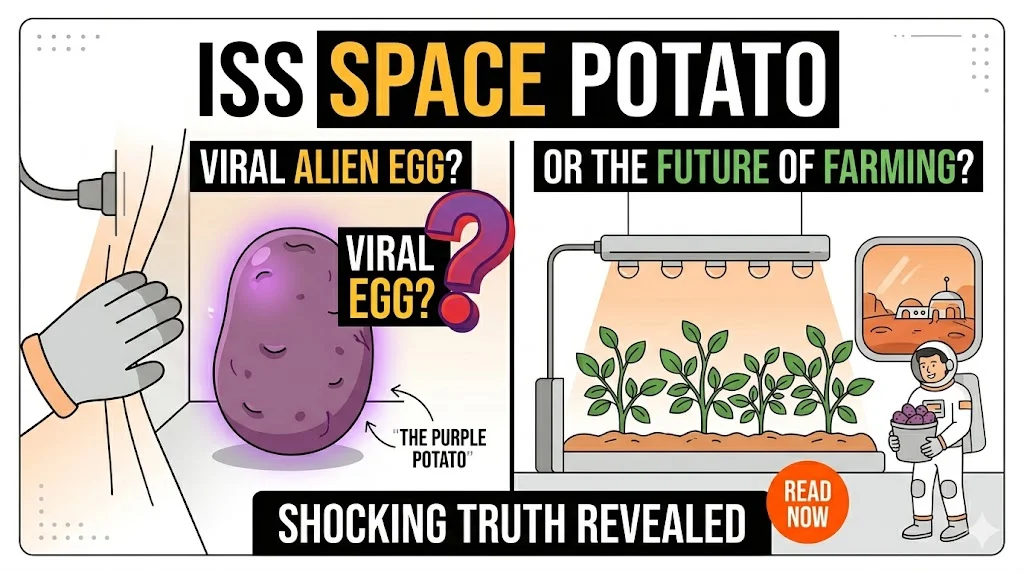
If you saw the trending “ISS space potato” photo and thought it was some alien creature, you’re not alone. Over the last few days, this strange purple object floating inside the International Space Station has gone viral across social media. People were confused, scared, and honestly, a bit amused. But here’s the twist. It’s just a potato.
The keyword “ISS space potato” is blowing up right now because it connects curiosity, science, and a bit of meme culture. This isn’t just about a funny image. It’s actually a glimpse into how humans might grow food in space in the future. And trust me, the real story is way more interesting than the clickbait headlines.
Key Takeaways
- The viral “alien egg” is actually a purple potato grown in space
- NASA astronaut Don Pettit created it during his off-duty time
- Named “Spudnik-1” as a fun reference to Sputnik
- Roots grow in random directions due to microgravity
- Growth is slower compared to Earth
- This experiment highlights the future of space farming
- Public reaction mixed humor, memes, and genuine curiosity
Table of Contents
What Is ISS Space Potato And Why It Went Viral
The whole story started when astronaut Don Pettit shared a photo online. The image showed a purple, egg-shaped object with tentacle-like roots floating in space. No soil, no pot, nothing normal. Just vibes.
Naturally, the internet lost it.
People started calling it an alien egg, some even compared it to horror movies. A lot of users joked “burn it” or “kill it with fire.” The visual was just too weird to ignore. But once the truth came out, the panic turned into fascination. This is exactly why the story blew up. It had everything. Mystery, shock, science, and meme potential.
The Truth Behind Spudnik-1
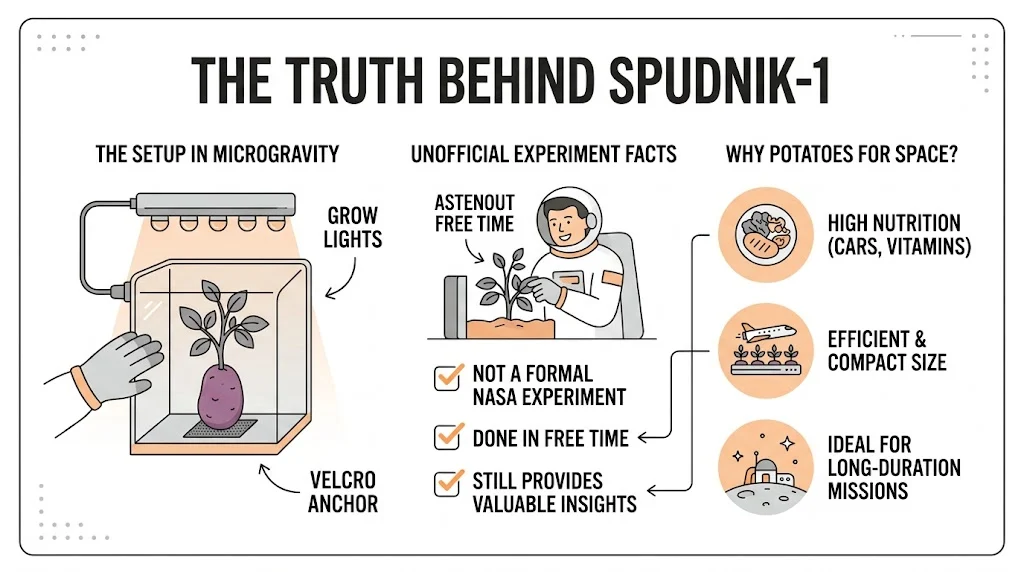
The object is actually a purple potato grown on the ISS during Expedition 72. Pettit named it “Spudnik-1,” which is honestly genius.
He grew it inside a small improvised setup using grow lights and a Velcro anchor to keep it from floating away. Simple jugaad but very effective. In microgravity, even the smallest objects can drift uncontrollably, so anchoring the plant was essential for stability and observation. The grow lights provided the necessary spectrum for photosynthesis, replacing natural sunlight, which is not directly accessible inside the station.
What makes this experiment even more fascinating is how it reflects real-world challenges scientists face when designing sustainable food systems for space missions. Unlike controlled lab experiments on Earth, space introduces variables like radiation exposure, limited water availability, and lack of gravity—all of which affect plant growth in unpredictable ways.
Here’s what makes it interesting:
- It’s not a formal NASA experiment
- It was done during free time
- It still gives valuable insights into plant growth in space
Even though it wasn’t officially part of NASA’s research program, informal experiments like this often spark new ideas and innovations. Astronauts frequently use their downtime to explore creative solutions, and sometimes these small trials lead to breakthroughs in larger scientific missions.
Potatoes were chosen because they are highly efficient. They provide good nutrition relative to their size. This makes them ideal for long space missions. Additionally, potatoes are rich in carbohydrates, vitamins like Vitamin C, and essential minerals, making them a compact yet powerful food source. Their ability to grow in confined environments with minimal resources makes them a strong candidate for future space agriculture systems, especially for missions to Mars or long-duration stays on the Moon.
How Potatoes Grow In Space (And Why They Look So Weird)
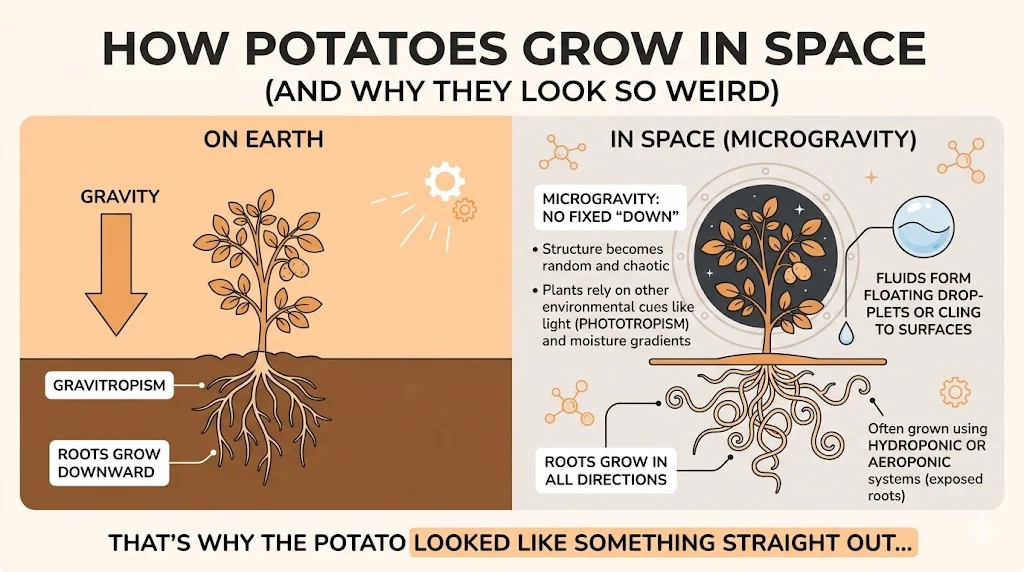
This is where things get really interesting. On Earth, gravity controls everything. Roots grow downward, stems grow upward. Simple. This process is called gravitropism, where plants sense gravity and adjust their growth accordingly. Roots move toward gravity (positive gravitropism), while shoots grow away from it (negative gravitropism). This natural system helps plants anchor themselves and efficiently absorb water and nutrients from the soil.
In space, however, there is microgravity, which means gravity is extremely weak and almost negligible.
So what happens?
- Roots grow in all directions
- There is no fixed “down”
- The plant structure becomes random and chaotic
Without gravity, plants rely on other environmental cues like light (phototropism) and moisture gradients to guide their growth. However, these signals are not always strong or consistent enough to fully replace gravity. As a result, roots may twist, curl, or spread unpredictably, creating unusual shapes that look unfamiliar to us.
Another important factor is the absence of soil. On the ISS, plants are often grown using hydroponic or aeroponic systems, where nutrients are delivered through water or mist. This means roots are exposed rather than buried, making their irregular growth patterns even more visible.
Additionally, microgravity affects how fluids behave. Water doesn’t flow downward but instead forms floating droplets or clings to surfaces. This can make it harder for plants to absorb water evenly, further influencing their growth patterns and slowing development compared to Earth.
That’s why the potato looked like something straight out of a sci-fi movie. The roots were exposed and spreading everywhere instead of being hidden in soil.
Comparison Of Growth: Earth Vs Space
| Factor | Earth Growth | Space Growth (ISS) |
|---|---|---|
| Root Direction | Downward | Random directions |
| Growth Speed | Faster | Slower |
| Structure | Organized | Chaotic |
| Soil Presence | Yes | No |
| Visual Appearance | Normal | Alien-like |
This table clearly shows why the potato looked so unusual.
Why NASA Is Interested In Space Farming?
This is not just a fun experiment. It connects to a much bigger challenge that space agencies around the world are actively trying to solve.
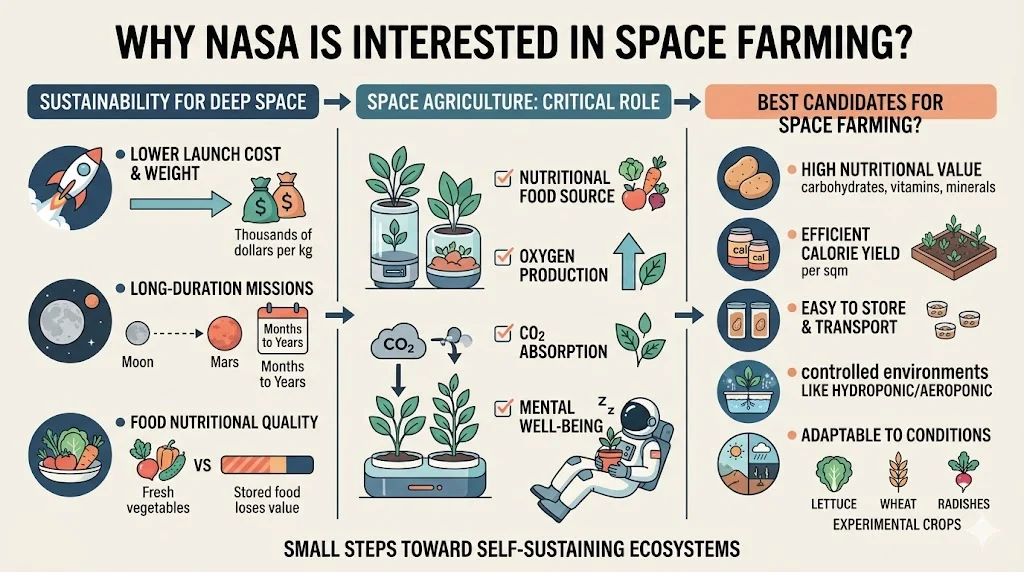
If humans want to go to Mars or establish long-term bases on the Moon, carrying all food from Earth is simply not sustainable. Every kilogram launched into space costs thousands of dollars, and missions lasting months or years would require massive food supplies. Over time, stored food also loses nutritional value, making it even less reliable for long-duration missions.
That’s why astronauts will need to grow their own food in space.
This concept is known as space agriculture, and it plays a critical role in future human survival beyond Earth. Growing food in space is not just about nutrition—it also helps with oxygen production, carbon dioxide absorption, and even mental well-being for astronauts living in isolated environments.
Potatoes are considered one of the best candidates for space farming because:
- High nutritional value (rich in carbohydrates, vitamins, and minerals)
- Efficient calorie yield per square meter
- Easy to store and transport before planting
- Can grow in controlled environments like hydroponic or aeroponic systems
- Adaptable to different growing conditions
In addition to potatoes, scientists are also experimenting with crops like lettuce, wheat, and radishes on the ISS. These experiments help researchers understand how plants behave in microgravity, how roots absorb nutrients without soil, and how artificial lighting affects growth cycles.
This idea is not new. Even the movie “The Martian” popularized the concept of growing potatoes for survival on Mars. But what once seemed like science fiction is now becoming a serious area of research.
Experiments like the ISS space potato are small but important steps toward building self-sustaining ecosystems in space. Each successful attempt brings us closer to a future where humans can live, work, and grow food beyond Earth without depending entirely on supply missions from home.
Public Reaction On Twitter (X): Meme + Science Combo
The Twitter reaction is honestly one of the best parts of this story.
Based on recent trends, here’s what people are saying:
1. Initial Freakout
People genuinely thought it was something alive. Comments like:
- “Burn it!”
- “That’s definitely an alien egg”
- “No way this is real”
2. Meme Culture
Users turned it into jokes instantly:
- Comparing it to horror movies
- Calling it a “space creature”
- Even creating meme coins like “Spudnik-1”
3. Science Appreciation
Some users actually focused on the bigger picture:
- Future of food in space
- Importance of sustainable missions
- Curiosity about plant behavior
4. Wholesome Curiosity
Many people were just amazed:
- “Space farming is real now”
- “This is actually beautiful”
- “Humans growing food in space is crazy”
Overall sentiment is positive, fun, and curious. Very rare internet moment.
What Competitors Missed (And What You Should Know)
After analyzing multiple articles, one thing is clear. Most of them focused only on the viral aspect.
But here’s what they missed:
- Real explanation of microgravity plant behavior
- Clear comparison between Earth and space growth
- Public sentiment breakdown from social media
- Connection to future Mars missions in a practical way
- Search intent around “how plants grow in space”
This article fills those gaps so readers actually learn something useful, not just scroll and forget.
Bigger Picture: Small Potato, Big Future
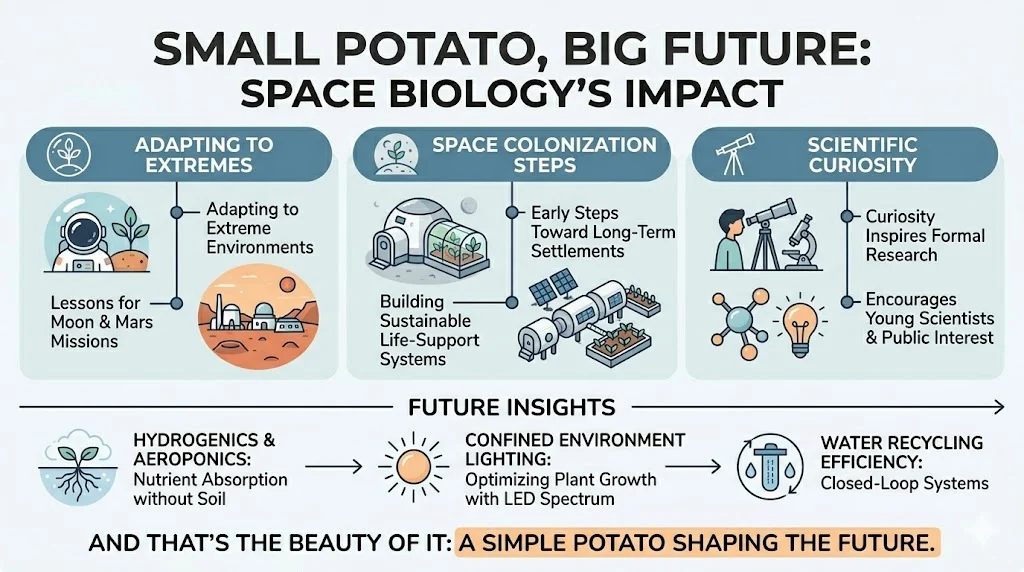
At first glance, it’s just a funny story.
But if you think deeper, this tiny potato represents something huge. It’s not just about a viral image or a quirky experiment. It’s about how humanity is slowly learning to survive beyond Earth. Every small test like this adds to a growing body of knowledge that scientists will rely on when planning long-duration missions to the Moon, Mars, and beyond.
It shows:
- Humans adapting to extreme environments
- Early steps toward space colonization
- How science and curiosity go hand in hand
But there’s more beneath the surface. Growing food in space is one of the biggest challenges for future astronauts. Without gravity, plants behave differently, water distribution becomes tricky, and maintaining nutrients is complex. Experiments like this help researchers understand how to control these variables in microgravity conditions.
For example, scientists are studying how roots absorb nutrients without soil, how light affects plant growth in confined environments, and how to recycle water efficiently. These insights are critical for building sustainable life-support systems in space habitats.
Even a simple off-duty experiment can contribute to something bigger. It can inspire formal research, spark public interest, and even encourage young scientists to explore space biology. Innovation often starts with curiosity, and sometimes the most unexpected experiments lead to breakthrough discoveries.
And that’s the beauty of it.
Final Thoughts
The “ISS space potato” might look strange at first, but honestly, it’s a small reminder of how far we’ve come and how much further we can go. Something as simple as a potato floating in space tells us that the future isn’t as distant as it once felt.
If there’s one thing to take from this, it’s that big ideas don’t always start big. Sometimes they begin with curiosity, a bit of creativity, and the willingness to try something new even during your free time.
So next time you see something weird or unexpected, don’t just scroll past it. Pause for a second. There might be a bigger story behind it, just like this one.
Related Posts :




Share This Post