Power Grid Share Price Target 2026, 2027, 2029, 2030, 2040, 2050
Power Grid Corporation Share Price Target 2026, 2027, 2028, 2029
Power Grid Corporation is India’s largest power transmission company. It operates and maintains a vast network that carries nearly half of India’s electricity. The company plays a key role in connecting power generation with distribution across states. It also supports renewable energy integration, data centers and cross-border transmission projects.
In the last 5 years the company has shown steady financial growth. Revenue increased from ₹36,327 crore in FY21 to ₹52,678 crore in FY25. Net profit also grew from ₹8,959 crore to ₹17,243 crore. This shows strong and stable business performance. Promoter holding is stable at around 51 percent which reflects government backing. The company also provides regular dividends which makes it attractive for income investors.
Recent news is very positive for the company. It has increased its capex guidance to ₹32,000 crore for FY26 which shows strong growth visibility. The company is also planning to merge 28 subsidiaries to improve efficiency. It has a strong order book of around ₹1.45 trillion and is expanding into renewable energy transmission and international projects like Uganda.
In this article we are going to see the Share Price Target of power grid with fudamental & numeric data and try to see how much returns can you expect from this share in upcoming years.
Table of Contents
Power Grid Share Price Target 2026
| Month | Minimum Price (₹) | Maximum Price (₹) |
|---|---|---|
| Jan | 250 | 300 |
| Feb | 260 | 320 |
| Mar | 270 | 330 |
| Apr | 280 | 340 |
| May | 290 | 350 |
| Jun | 295 | 360 |
| Jul | 300 | 370 |
| Aug | 305 | 380 |
| Sep | 310 | 390 |
| Oct | 315 | 395 |
| Nov | 320 | 400 |
| Dec | 330 | 420 |
The 2026 outlook looks stable with moderate upside. Strong capex and project execution support growth. Renewable energy integration and transmission demand are key drivers.
Power Grid Share Price Target 2027
| Year | Month | Minimum Price (₹) | Maximum Price (₹) |
|---|---|---|---|
| 2027 | Jan | 320 | 380 |
| 2027 | Dec | 350 | 450 |
By 2027, the company may benefit from ongoing projects and higher capitalisation. Transmission demand from data centers and EV infrastructure can boost growth.
Power Grid Share Price Target 2028
| Year | Month | Minimum Price (₹) | Maximum Price (₹) |
|---|---|---|---|
| 2028 | Jan | 360 | 420 |
| 2028 | Dec | 400 | 520 |
India’s renewable energy push will increase transmission demand. The company’s dominant position will help capture this growth.
Power Grid Share Price Target 2029
| Year | Month | Minimum Price (₹) | Maximum Price (₹) |
|---|---|---|---|
| 2029 | Jan | 420 | 550 |
| 2029 | Dec | 480 | 650 |
Large scale transmission projects and policy support will drive growth. Operational efficiency will also improve after subsidiary merger.
Power Grid Share Price Target 2030
| Year | Month | Minimum Price (₹) | Maximum Price (₹) |
|---|---|---|---|
| 2030 | Jan | 500 | 800 |
| 2030 | Dec | 700 | 1060 |
By 2030, the company may see strong growth from energy transition. Electricity demand in India will increase significantly.
Also Read: BPCL Share Price Target 2026, 2027, 2028, 2029, 2030, 2040, 2050, 2060
Power Grid Share Price Target 2040
| Year | Month | Minimum Price (₹) | Maximum Price (₹) |
|---|---|---|---|
| 2040 | Jan | 1000 | 1300 |
| 2040 | Dec | 1200 | 1450 |
Long term growth will come from grid expansion and modernization. Renewable energy integration will remain a major driver.
Power Grid Share Price Target 2050
| Year | Month | Minimum Price (₹) | Maximum Price (₹) |
|---|---|---|---|
| 2050 | Jan | 1200 | 1400 |
| 2050 | Dec | 1300 | 1500 |
The company can remain a key infrastructure player for decades. Stable returns and dividend income will attract long term investors?
Should I Buy Power Grid Share?
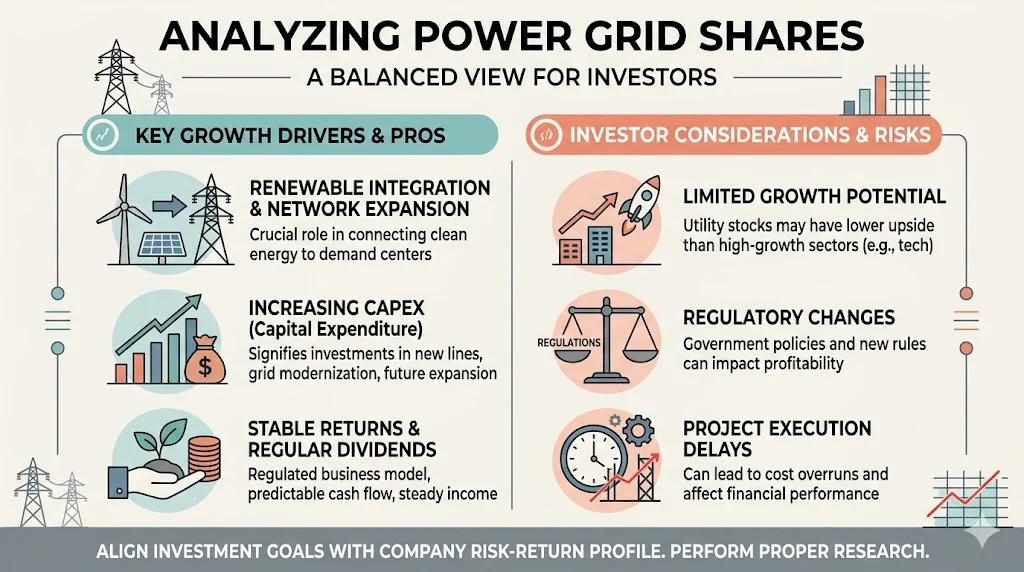
The company is focusing on expanding its transmission network and renewable integration. This is a major growth driver as India continues to shift towards clean energy sources like solar and wind. Power Grid plays a critical role in connecting renewable energy generation sites, which are often located in remote areas, to demand centers across the country. This ensures efficient power distribution and supports the government’s ambitious renewable energy targets.
It is also increasing its capex which shows future expansion plans. Higher capital expenditure indicates that the company is actively investing in new transmission lines, substations, and grid modernization projects. These investments not only strengthen its infrastructure but also ensure long-term revenue visibility, as most of its projects operate under regulated returns. Additionally, the company is exploring opportunities in international markets and smart grid technologies, which can further diversify its revenue streams.
The company provides stable returns and regular dividends. Due to its regulated business model, Power Grid enjoys predictable cash flows, making it a preferred choice for conservative investors seeking steady income. Its consistent dividend payouts make it attractive for long-term investors who prioritize income along with moderate capital appreciation.
However, investors should do proper research. Utility stocks may have limited upside compared to high growth stocks. While Power Grid offers stability, its growth rate may not match that of emerging sectors like technology or manufacturing. Factors such as regulatory changes, interest rate fluctuations, and project execution delays can also impact performance. Therefore, investors should align their investment goals with the company’s risk-return profile before making a decision.
Also Read: 20 Stock Falling Since Last 6 Months
Is Power Grid Stock Good to Buy (Bull Case & Bear Case)
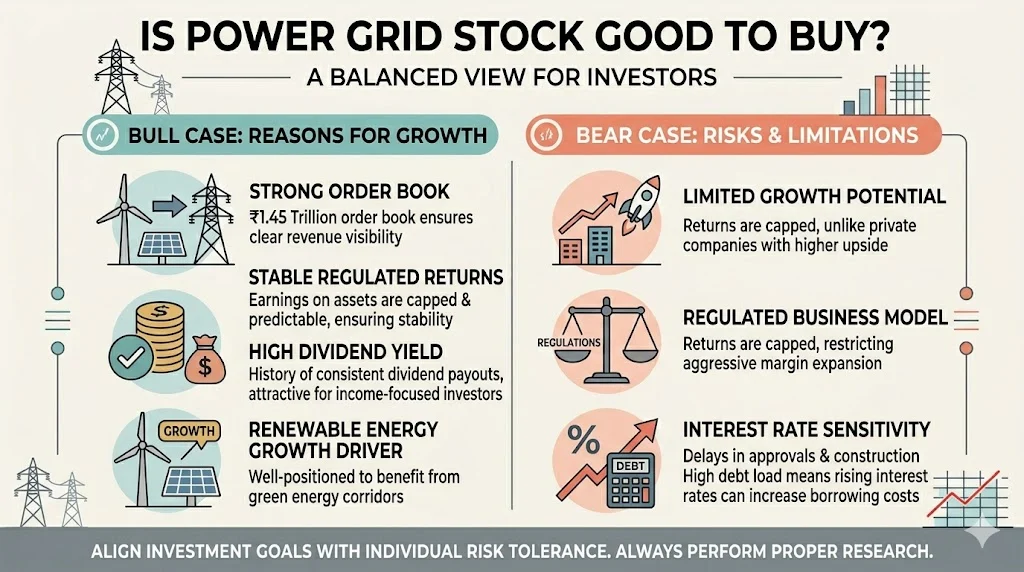
Bull Case:
- Strong order book of ₹1.45 trillion
- Stable regulated returns
- High dividend yield
- Government support
- Growth from renewable energy
Power Grid Corporation has a very strong business foundation due to its regulated model. The company earns fixed returns on its transmission assets, which ensures predictable and stable cash flows. This makes it less risky compared to many other sectors. The large order book of ₹1.45 trillion provides clear visibility of future revenue growth for the next few years.
Another major advantage is its consistent dividend payout. The company has a history of rewarding shareholders with regular dividends, making it attractive for long-term and income-focused investors. Government backing also adds an extra layer of safety, as the company plays a critical role in India’s power infrastructure.
The biggest growth driver going forward is renewable energy. As India increases its solar and wind capacity, the need for transmission infrastructure will rise significantly. Power Grid is well positioned to benefit from this transition, especially with its ongoing investments in green energy corridors and interstate transmission projects.
Bear Case:
- Limited high growth potential
- Regulated business model
- Execution risks in projects
- Interest rate sensitivity
Despite its strengths, the company has some limitations. The regulated nature of the business means that returns are capped, which restricts high growth potential. Unlike private sector companies, it cannot significantly increase margins beyond a certain level.
Project execution is another risk factor. Delays in approvals, land acquisition, or construction can impact revenue recognition and profitability. Additionally, since the company relies heavily on debt to fund its capital expenditure, rising interest rates can increase borrowing costs and affect earnings.
Overall, while Power Grid offers stability and steady returns, it may not be suitable for investors looking for aggressive growth.
Quantitative Analysis of Power Grid
| Metric | Value | Analysis |
|---|---|---|
| Revenue Growth | Stable (8-10%) | Consistent growth |
| Profit Growth | Strong | Increasing profitability |
| EPS Trend | Rising | Improving earnings |
| ROE | ~20% | Good return ratio |
| Debt-to-Equity | ~1.3 | Moderate leverage |
| Net Profit Margin | ~32% | High margin business |
| Market Cap | ₹2.9L Cr | Large cap company |
| Dividend Yield | ~3.5% | Strong income stock |
| Promoter Holding | ~51% | Stable government ownership |
Revenue growth is steady which reflects the stable nature of the business. Transmission companies usually do not grow very fast but they provide consistent income. Based on the above table, this steady growth pattern highlights the company’s predictable revenue model and long-term sustainability.
Here are the key insights explained in a structured way:
- Stable Revenue Growth
- Revenue growth remains in the range of 8–10 percent annually.
- This reflects the regulated nature of the transmission business.
- Unlike cyclical industries, revenue is not highly volatile.
- Long-term contracts ensure consistent income visibility.
- Strong Profit Growth
- Profit growth is strong due to regulated returns set by authorities.
- The company earns fixed returns on capital employed.
- This reduces uncertainty in earnings.
- Predictable profits make it attractive for conservative investors.
- Healthy Return on Equity (ROE)
- ROE around 20 percent indicates efficient capital utilization.
- It shows that the company is generating good returns on shareholder funds.
- Compared to other PSU companies, this is a strong performance metric.
- Consistent ROE reflects operational efficiency.
- Moderate Debt Levels
- Debt-to-equity ratio is around 1.3 which is manageable.
- Infrastructure companies usually operate with higher debt.
- Stable cash flows help in servicing debt comfortably.
- Low risk of financial stress due to predictable earnings.
- High Profit Margins
- Net profit margins are around 30 percent or higher.
- This is due to the low operating cost model.
- Transmission business does not require high recurring expenses.
- High margins improve overall profitability.
- Attractive Dividend Yield
- Dividend yield is around 3–4 percent.
- The company regularly distributes profits to shareholders.
- This makes it a strong income-generating stock.
- Suitable for long-term investors seeking passive income.
- Strong Promoter Holding
- Promoter holding is around 51 percent.
- Government ownership provides stability and trust.
- Lower risk of sudden management changes.
- Ensures long-term strategic direction.
Overall, the company shows a balanced financial profile with steady growth, strong profitability, and reliable income generation. It may not deliver very high growth like emerging sectors, but it offers stability, predictability, and consistent returns which are ideal for long-term investors.
My Final Words On Power Grid Corporation
Power Grid Corporation is one of those companies that quietly does its job without much noise. It may not be the kind of stock that doubles overnight, but it offers something many investors truly need — stability and peace of mind.
One of the biggest strengths of the company is its regulated business model. Unlike many other sectors, power transmission operates under fixed returns approved by regulators. This means the company earns predictable income regardless of short-term market fluctuations. For investors this translates into steady earnings visibility and lower volatility compared to cyclical stocks.
Another important factor is its strong dividend track record. Power Grid has consistently paid dividends over the years, making it attractive for income-focused investors such as retirees or those looking for passive income. The combination of stable cash flows and regular payouts makes it a reliable long-term holding.
As India’s power demand keeps growing and renewable energy expands, the company is likely to stay relevant for a long time. The shift towards solar and wind energy requires a strong transmission network, and Power Grid plays a critical role in connecting these energy sources to the grid. This structural demand ensures long-term growth opportunities.
However, investors should also understand its limitations. Since it is a regulated utility, the upside potential may be limited compared to high-growth sectors like technology or small-cap stocks. Returns are generally steady but not explosive.
If you are looking for quick gains, this might not be the right choice. But if your goal is to build a stable portfolio with regular income and lower risk, Power Grid can be a sensible addition. At the end of the day, investing is personal. Think about your goals, your risk tolerance, and your time horizon. If you value consistency and long-term security, this stock could fit well into your journey.
Related Posts :




![Government Loan Schemes In 2026: Smart Funding Options Every Indian Must Know [With Calculators]](https://governmentcsc.com/wp-content/uploads/2026/03/Government-Loan-Schemes-In-2026-Smart-Funding-Options-Every-Indian-Must-Know-With-Calculators.webp)

Share This Post